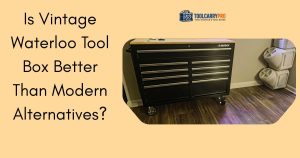
You walk into Home Depot or pull up Harbor Freight’s website, take one look at the price tag on a decent rolling cabinet, and suddenly feel like you need a moment alone. A steel box with drawers. How is it $800? How is that Snap-on unit $5,000?
It is a fair question, and it is one that almost every mechanic and home DIYer asks at some point. At ToolCarryPro, the goal has always been to give you the honest, specification-driven answer instead of a sales pitch. So here is the real breakdown of why toolboxes cost as much as they do, and what you are actually paying for when you spend that money.

It Starts With the Steel
The single biggest cost driver in any quality toolbox is the material. A professional-grade rolling cabinet is not built from thin sheet metal. It is constructed from thick-gauge steel, often 18 to 21 gauge depending on the tier, because anything lighter bends under load, warps from drawer slams, and fails within a few years of regular use.
Steel prices have risen substantially over the years, and the thicker the steel, the stronger the toolbox, and the more it costs. Tools Buying Guide A cheap cabinet flexes when you load the top shelf with a torque wrench set. A well-built one does not move at all.
For home mechanics building out their garage, understanding this trade-off is important before you buy. If you are still figuring out your full setup, the guide on ToolCarryPro covering the best toolboxes and wall storage systems for mechanics at home breaks down which steel-constructed units are actually worth the price at different budget levels.
The Drawer Slides Are More Expensive Than You Think
This is where most buyers get surprised. The drawer slide mechanism inside a quality toolbox is not a simple metal rail. It is a precision-engineered bearing system.
High-quality toolboxes use ball-bearing slides, sometimes 8 to 10 bearings per slide, engineered to handle serious loads. A single good slide mechanism can cost between $10 and $25 wholesale. Tools Buying Guide When you multiply that across 9 or 11 drawers, each with two slides, the hardware cost alone climbs into the hundreds of dollars before a single piece of steel is cut.
This is exactly why a drawer on a $400 Husky cabinet feels noticeably smoother than one on a $150 plastic unit. You are paying for the mechanism, not just the box around it.
| Quality Tier | Drawer Slide Type | Approx. Load Per Drawer | Price Range |
|---|---|---|---|
| Budget | Basic steel rail | 30 to 50 lbs | $100 to $200 |
| Mid-range | Ball-bearing slides | 100 to 150 lbs | $300 to $600 |
| Professional | Full-extension ball-bearing | 200 to 300 lbs | $800 to $2,000 |
| Pro-grade (Snap-on, Matco) | Heavy-duty carriage system | 400+ lbs | $3,000 to $15,000+ |
Manufacturing and Finishing Costs Add Up Fast
A toolbox is not stamped out in one press and shipped. It involves welding, grinding, fitting, powder coating, and quality testing before it leaves the factory.
Powder coating alone can cost more than $50 to $80 per unit in material and labor. Tools Buying Guide That coating is what protects the steel from rust in a humid Florida garage or a damp Pacific Northwest workshop. Skip it and you are watching your cabinet rust within two years.
The welding quality also matters more than most people realize. A poorly welded frame twists under load, causing drawers to bind and eventually fail. Precision welding takes skilled labor and time, both of which cost money at every point in the supply chain.
Tariffs and Import Costs Push Prices Higher
This is a factor that does not get talked about enough. One of the drivers of higher toolbox prices in the United States was tariffs, resulting from a US-based company petitioning the ITC that Chinese and Vietnamese manufacturers were dumping unfairly subsidized toolboxes into the US market. My Tractor Forum
Those tariffs raised the floor price on imported cabinets across the board. Whether a unit was made in China, Taiwan, or domestically, the ripple effect hit retail prices everywhere. If you have noticed toolbox prices feeling higher over the past few years, this is a big part of why.
Shipping a Heavy Steel Box Costs Real Money
A mid-range rolling cabinet weighs between 150 and 450 pounds. Freight shipping on a 200-pound item is not cheap, and that cost is built into the retail price whether the retailer calls it out or not.
This is also why buying in-store at places like Home Depot, Lowe’s, or Harbor Freight can sometimes save you money over ordering online. The unit is already at the warehouse. You do not pay for the last-mile freight that shows up quietly in the online price.
Brand Reputation Is a Real Part of the Price
Snap-on, Matco, and Mac Tools are not just selling steel. They are selling a lifetime warranty, a mobile truck that comes to your shop, financing options, and decades of brand reputation in the professional trades. Snap-on boxes are built and sold for the professional mechanic in a harsh environment, and they are made to last.
That does not mean you need to spend $5,000 as a home mechanic. But it does explain why the price exists. For a professional technician who opens and closes those drawers 50 times a day, every day, for 20 years, the per-use cost of a Snap-on cabinet is actually very reasonable.
For home use, brands like Husky, Craftsman, and ICON from Harbor Freight offer genuine quality at a fraction of that price. The Montezuma tool box is another name worth looking at if you need a capable cabinet without the premium brand markup, particularly for mobile mechanics who need durability on the road.
So Is It Actually Worth Spending More?
The honest answer is: it depends on how often you use it.
For a mechanic turning wrenches daily, a cheaper cabinet will frustrate you within a year. Sticky drawers, bent frames, and rust are not minor inconveniences when you rely on your storage to work fast.
For a weekend DIYer doing oil changes, brake jobs, and the occasional suspension work, a mid-range unit from Husky or Craftsman is genuinely good enough and holds up well for years with basic care.
| User Type | Recommended Spend | Best Options |
|---|---|---|
| Occasional home use | $300 to $500 | Craftsman 2000 Series, Husky 46-inch |
| Regular home mechanic | $500 to $900 | ICON Roll Cab, DeWalt ToughSystem |
| Mobile mechanic | $600 to $1,200 | Montezuma, DeWalt ToughSystem 2.0 |
| Professional shop use | $1,500 and up | Snap-on, Matco, Lista |
If you are organizing a broader tool setup and not just the cabinet itself, it is worth reading through how other professionals approach storage. The post on ToolCarryPro about organizing an electrician tool bag covers the same principle: the right container for the right tool makes a measurable difference in how efficiently you work.
The Right Size Matters Too
Part of why toolboxes seem expensive is that buyers often buy more cabinet than they need, or worse, too little and end up buying twice. Getting the size right the first time saves you real money.
If you are unsure which size fits your current collection and where you expect it to grow, the Toyo tool box size guide on ToolCarryPro walks through how to match cabinet dimensions to your actual inventory, which is a useful framework even if you are shopping a different brand.
Final Thought
Toolboxes are expensive because they are built to carry hundreds of pounds of metal tools, survive garage humidity, handle years of daily use, and still open and close smoothly a decade from now. The materials, hardware, finishing, shipping, and brand infrastructure all feed into that price.
That said, expensive does not always mean right for your situation. Spend what matches how seriously you use it, prioritize steel construction and quality drawer slides above everything else, and you will get more value per dollar than any box with a famous logo and a payment plan attached.
Disclaimer – No Affiliate Links:We are not using any affiliate links on this site. This blog is written solely with the aim of helping our readers to make informed unbiased decisions.